
Summer Car Maintenance Checklist: 12 Things to Inspect Before a Road Trip
There are a few key car problems that cause the AAA to rescue 7 million drivers every summer? Spoiler Alert: Almost all of them show up in a simple 20-minute driveway check. Are you ready for summer?

On this page
- 1. Tire pressure (the cold-tire rule)
- 2. Tread depth (the quarter test)
- 3. The spare nobody looks at
- 4. Battery age and a real load test
- 5. Terminal corrosion
- 6. Oil level and condition
- 7. Coolant, brake fluid, transmission fluid
- 8. Belts and hoses
- 9. A/C performance (test it now, not at mile 200)
- 10. Wiper blades and washer fluid
- 11. Open recalls (the free check almost nobody runs)
- 12. Emergency kit (the stuff you hope to never open)
The car's loaded, the kids are buckled, the coffee's in the cupholder, and somewhere around mile 47 a light comes on the dashboard...and nobody sees it. Yup, that spells trouble. The AAA helps roughly 7 million motorists every summer for the same set of reasons. And, as you might guess, almost all of car issues are catchable in a driveway the night before.
This checklist takes maybe 20 minutes. If you've got a tire gauge and a flashlight, you have all the tools you'll need. Many ask, "do I need automotive expertise?" No, none of it requires a mechanic unless you find something suspect or in serious need of repair. And the thing you find before you leave, is always cheaper than the thing you find at a rest stop off I-80 with a back seat full of sugar-infused, hyperactive kids.
Before we get to the list, let's give you a little perspective. The AAA projected 61.6 million people would travel by car over Independence Day 2025, the highest car-travel volume on record. Even more are expected during this 2026 summer holiday. More cars on the road means more cars on the shoulder.
The point of this list isn't to scare you, it's to make sure the car you packed is the same car that pulls into the driveway a week later.
1. Tire pressure (the cold-tire rule)
Tires are the cheapest fix on this whole list and the one most people get wrong. Not because they don't check. Because they check the wrong number, at the wrong time, against the wrong reference.
Where to find the right number
The PSI (pounds per square inch) number you want is printed on the placard inside the driver's door jamb. That's the number the carmaker engineered for your car, with your suspension, hauling your stuff. NHTSA says explicitly that the correct PSI lives on the door placard, not the tire sidewall. The big number molded into the rubber is the tire's maximum, not your target.
Under-inflation is the top cause of summer blowouts. Hot pavement plus a soft tire plus highway speed equals a tire that flexes itself apart. You'll hear it before you see it.
Cold means cold
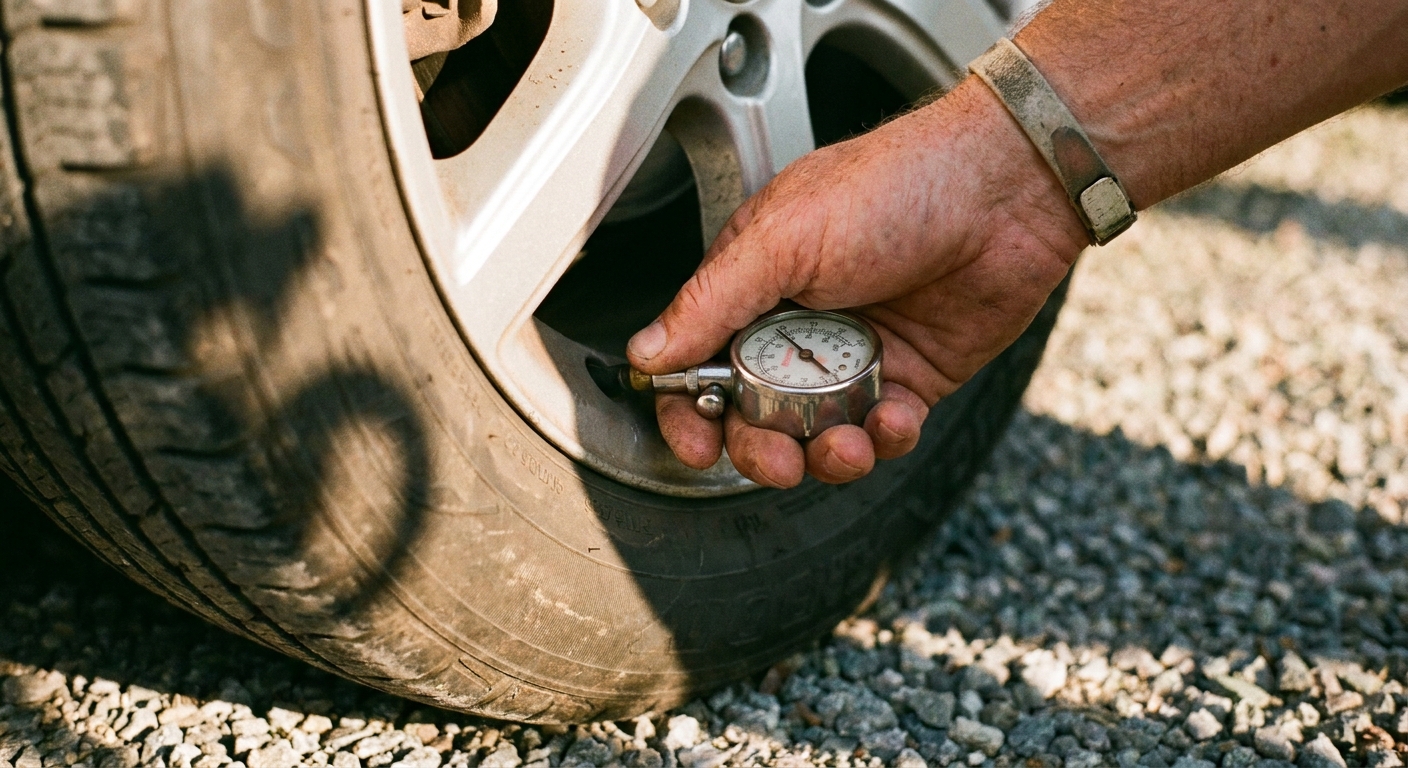
A tire is "cold" when the car has sat for three or more hours. If you drive to the gas station and check the air there, the reading is already off because the tires have heated up. Buy a $10 gauge. Check in the driveway before you leave.
(The gas station air pump is for emergencies, not for setup.)
2. Tread depth (the quarter test)
You may have heard of the penny test, where you stick a penny in the tread and worry if you can see Lincoln's whole head. AAA quietly updated the rule. The new test uses a quarter.
Insert a quarter into the tread groove with Washington's head pointing down. If you can see the top of his head, your tread is below 4/32 of an inch and you should be shopping for tires. The quarter catches worn tires earlier than the penny does, which matters because bald rubber on hot pavement in a sudden summer storm is how the worst hydroplaning of your life happens.
Check all four. Tires don't wear evenly, especially if your alignment has drifted or you're running a heavy roof box. The inside edge of the front tires is the spot that's quietly bald while the rest looks fine.
If you're rolling toward a Midwest weekend trip from Chicago with flat highway and not much weather drama, you have margin. If you're pointed at mountains, you don't. Replace before you go.
3. The spare nobody looks at
Pop the trunk floor. When was the last time you checked the spare? For most people, the honest answer is never.
Spares lose pressure sitting unused for years. AAA's pre-trip checklist explicitly includes checking all tires plus the spare to the manufacturer's PSI. A flat spare is the same as no spare, which means a tow even though there's a perfectly good wheel rolling around in the trunk well.
While you're back there, confirm the spare is actually there. Some newer cars ship without one. There's an inflator kit instead, which works for slow leaks and is useless if you hit something sharp. Know which one you have before you need to know.
The jack and lug wrench live in the same spot. Pull them out. Touch them. The first time you handle a jack should not be on the shoulder of a highway in the rain.
4. Battery age and a real load test
Here's the part most drivers get backward.
The summer myth, busted
Cold cranks a battery hard, but heat is what kills it. Both Consumer Reports and AAA Via Magazine say the same thing: summer heat does more battery damage than winter cold. Heat speeds up the chemical reactions inside the battery and evaporates the internal fluids. The battery limps through July looking fine, then dies in October when the temperature drops and asks it to work hard for the first time in months.
The 3-year rule
Car batteries typically last 3 to 5 years, with a real geographic split. In the farthest northern US, the average is 58 months or more. In the most southern regions, it's less than 41 months. If you live anywhere south of, say, St. Louis, your battery has a shorter clock than the box suggests.
If yours is past three years old, get a free load test before you leave. Most auto parts chains do them in the parking lot for nothing. A load test measures whether the battery can actually deliver power under demand, which is different from whether it can hold a surface charge.
Worth knowing how big this category is. AAA received over 27 million roadside service calls in 2024, and about 7 million of those involved batteries. That's not a rare problem. That's a quarter of all calls.
5. Terminal corrosion
Pop the hood. Look at the battery posts. If you see a white, green, or blue-tinged crust forming where the cables clamp on, that's corrosion. AAA flags this as a normal pre-trip thing to check, and the fix is dirt cheap.
Disconnect the negative cable first, then the positive. Scrub the posts and clamps with a wire brush and a paste of baking soda and water. Rinse with a little clean water, dry, reconnect positive first then negative. Done.
Why it matters: a corroded connection mimics a dying battery. Slow crank, hard start, the occasional no-start that fixes itself by the third try. People replace batteries that didn't need replacing because they never cleaned the terminals. Don't be that person.
If the corrosion keeps coming back fast after cleaning, the battery is likely venting. That's an actual replacement signal.
6. Oil level and condition
The dipstick is the single fastest check on this list. Ninety seconds. Tells you a lot.
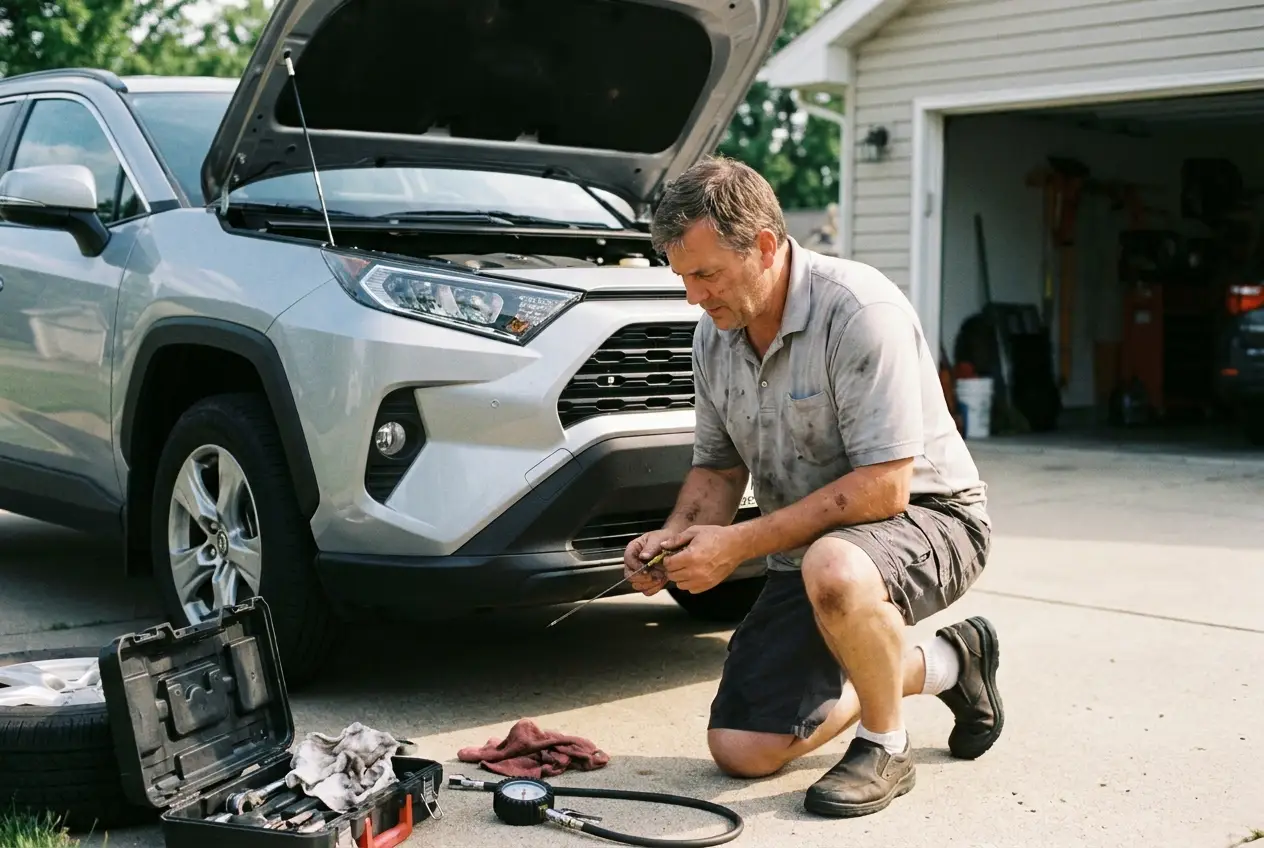
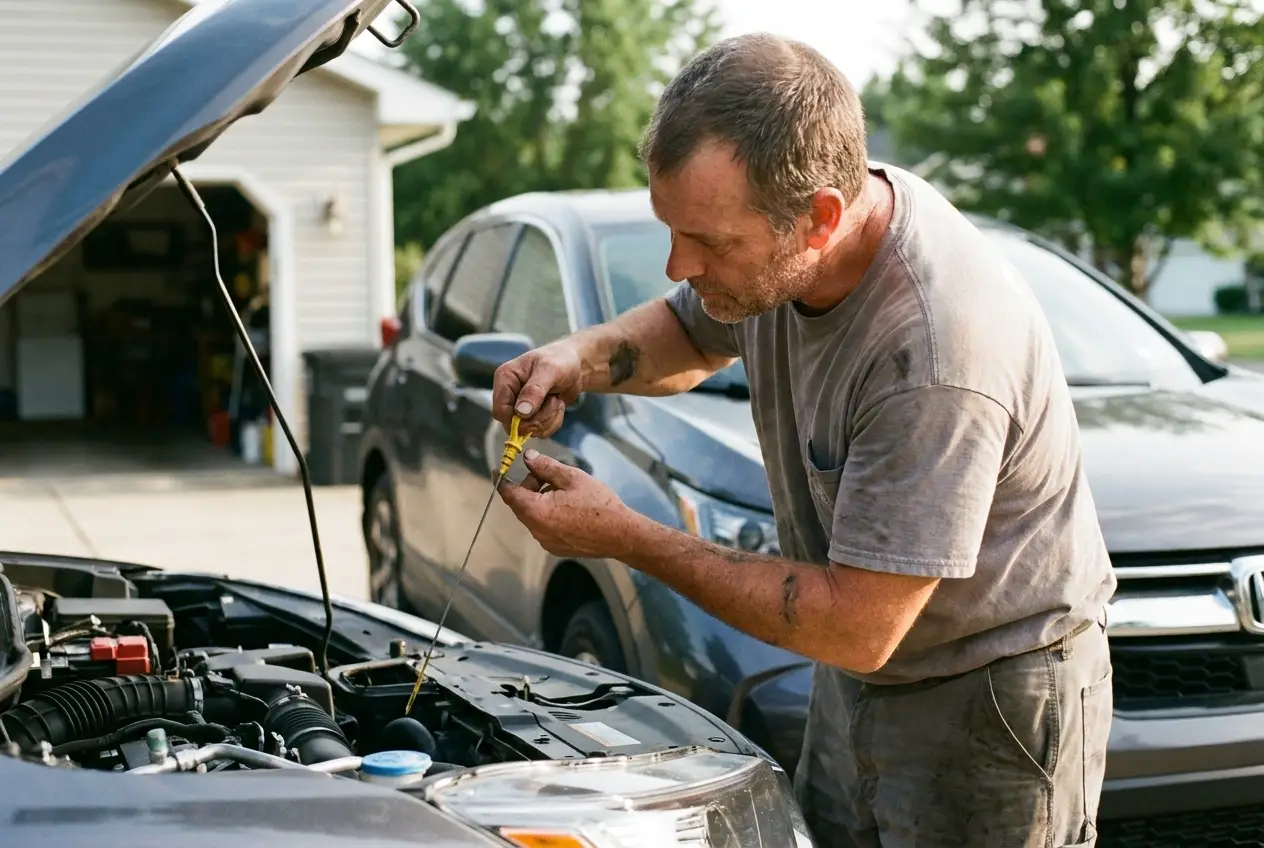
Park on level ground. Engine off, sat for at least a few minutes so the oil settles. Pull the dipstick, wipe it clean, push it all the way back in, pull it again. Read where the oil ends. It should sit between the two marks. If it's below the lower mark, add a quart of whatever weight the owner's manual specifies.
Now look at the oil itself. You want amber to medium brown. Black, sludgy, gritty? Overdue for a change. Milky or coffee-with-cream colored? That's coolant getting into the oil, which is a real problem and the trip is on hold until a mechanic looks at it.
Here's the honest part. If you're due for an oil change within the next 1,000 miles of the trip, do it before you go. A long highway run on tired oil is harder on the engine than a thousand miles of normal commuting.
7. Coolant, brake fluid, transmission fluid
These three live under the hood in their own little reservoirs, and most people open them roughly never.
The reservoirs you've never opened
Coolant. Look at the overflow tank, the translucent plastic one with MIN and MAX lines on the side. The fluid should sit between them. Color varies by type, green, orange, pink, blue, and you do not mix types. If you're low, top off with the same color that's in there. If you don't know what's in there, the owner's manual will tell you.
Brake fluid. Small reservoir, usually toward the back of the engine bay near the firewall. Check the level against the markings. Low brake fluid often means worn brake pads pulling fluid down into the calipers, not a leak. Either way, get it looked at before a long drive. Brakes are not the system to gamble on.
Transmission fluid. Some older cars have a dipstick for this, similar to the oil dipstick but usually farther back. Many newer cars are sealed, which means a shop has to check it. If yours has a dipstick, the fluid should be pinkish-red and not smell burnt. Burnt toast smell? That's a real warning.
Flush intervals
Coolant flush runs every two to five years depending on your car. Brake fluid every two to three years. Owner's manual has the exact interval for your make. If you can't remember when any of these were last done, the answer is "it's time."
8. Belts and hoses
NHTSA puts belts and hoses on the summer prep list, and they belong there because failures on the highway turn into overheated engines fast.
Pop the hood, find the serpentine belt, the long ribbed black belt snaking across the front of the engine. Look for visible cracks, frayed edges, glazed shiny patches. A few small cracks across the ribs is normal. A lot of them, or chunks missing, means it's near the end. A snapped serpentine belt strands the car within a few minutes because it powers the water pump and alternator.
Now squeeze the radiator hoses. The big ones running from the radiator to the engine. They should feel firm. Mushy, soft, or bulging spots are bad. So is any visible swelling near the hose clamps. A blown hose dumps coolant in seconds, and the engine overheats in roughly the time it takes you to find a safe exit.
Do this check when the engine is cold. Cold. Hot coolant under pressure is a burn you don't want.
9. A/C performance (test it now, not at mile 200)
Air conditioning is the easiest thing to defer and the worst one to discover broken halfway through Nebraska.
Why summer A/C fails at the worst time
NHTSA notes A/C works harder in heat, which is exactly when it tends to fail. Run yours on max cool with the windows up in the driveway. Stick a cheap thermometer in the center vent. The vent temperature should be 35 to 45 degrees colder than the outside air. If the outside is 90 and the vent is reading 75, something is wrong.
Weak airflow, warm air, or a clutch that won't kick in usually means low refrigerant or a failing compressor. Both are shop jobs. A refrigerant top-off at a shop is not a $1,000 fix. Driving 600 miles with a dead compressor and a 4-year-old in the back, though, is a different kind of expensive.
The kids-in-the-back factor
This is the part that matters more than people realize. NHTSA warns that inside-car temperatures can reach deadly levels in minutes when it's only in the low 80s outside. And a child's body temperature rises three to five times faster than an adult's.
That math doesn't only apply to parked cars. A car with a struggling A/C system in moving traffic with kids in the back is a slower version of the same problem. Back-seat vents matter more than front. Confirm they're actually blowing cold air. If your car has rear vents in the center console, run your hand in front of them. If they're warm or weak, the cabin filter might be clogged. That's a $20 part that takes ten minutes to swap.
10. Wiper blades and washer fluid
Wipers are the part you only notice when they fail, which is always during a storm at 70 mph.
The Car Care Council recommends replacing wiper blades roughly every six months. Summer thunderstorms drop more water in five minutes than a tired blade can clear. If yours streak, chatter, skip, or leave little rainbows of unwiped water, replace them. Don't clean them. They're done.
While you're there, top off the washer fluid. Bugs at highway speed will fog a windshield faster than rain will. Cornfield country in July is essentially a bug snowstorm, and a dry washer reservoir means you're driving by feel.
A small thing, but: pop the wipers up off the windshield and look at the rubber edge. If it's gummy, split, or curling at the corners, that's the signal. New blades run about $20 a pair and clip on in two minutes.
11. Open recalls (the free check almost nobody runs)
This one is wild because it's free, takes 30 seconds, and most owners have no idea it exists.
NHTSA hosts a free, VIN-based recall search at nhtsa.gov/recalls. Type in your 17-character VIN, which is on the dash where the windshield meets it on the driver's side, and the site tells you whether your specific car has any open recalls. Recalls are defects the manufacturer is legally obligated to fix at no cost to you. Parts, labor, all of it.
The catch is that recall notification mailers get lost. Owners change. Used-car buyers often have no idea the car they bought has an open recall sitting on it. The fix is sitting at a dealer service department, paid for, waiting.
Run yours before any long trip. Thirty seconds. If the recall covers something like a brake hose, fuel pump, or airbag, you'll be glad you found out in the driveway and not in a turn lane.
This is also the move for budget-conscious weekend trips from Chicago. Free repairs are the cheapest repairs.
12. Emergency kit (the stuff you hope to never open)
Last item. The stuff that sits in the trunk and earns its space the one time you need it.
The bare minimum
- Jumper cables or a portable jump pack. A pack is better. Doesn't need a second car to work. Charge it before you leave.
- At least one gallon of water per person. Drinking, radiator top-off, washing road rash off a skinned knee. Water is the one thing you can't improvise.
- First aid kit. The basic drugstore one is fine. Add a few extra bandages and any meds your crew actually takes.
- Flashlight with fresh batteries. Phone flashlights eat your battery exactly when you need the phone for everything else.
- Phone charger that fits everyone's phone. Cables and a multi-port adapter. The teen with the dying phone is its own emergency.
- Roadside flares or a reflective triangle. If you're stopped on a shoulder at dusk, this is what makes the next driver see you in time.
- Paper map of the route. Cell service drops in cornfield country and in the canyon stretches out west. A $5 atlas has saved more trips than any app.
The extras worth the trunk space
- Tire plug kit. $15. Plugs a nail puncture in five minutes, gets you to the next exit, and is cheaper than a tow truck by a factor of about 20.
- A few microfiber towels. Spills, fogged windshields, cleaning the dipstick.
- Sunscreen and extra cash. Both are easy to forget. Both matter when you've forgotten them.
- Snacks the kids haven't seen in the pantry for two weeks. This is emergency morale, not emergency food. A novel snack at hour four is worth more than another sandwich.
If you want a fuller take on the in-car side of all this, the family road trip rundown has more on what to actually do with the kids once the car is rolling and the checklist is in the rearview. DashDashBoom handles that stretch too, if the back seat needs something to do besides stare at a screen.