
Best Road Trip Routes Out West: Where to Go for Stunning Scenery
Six western drives, ranked by what they actually deliver between the trailheads: ocean cliffs, red rock, alpine switchbacks, and one road Charles Kuralt called the most beautiful in America.

On this page
Get ready. We're about to tell you about the drives that are worth the miles. Real numbers, real crowding warnings, and an honest read on which ones work with kids in the back.
Some of these are a week. One is two. One you can do in three days if you skip Big Sur, which you shouldn't.
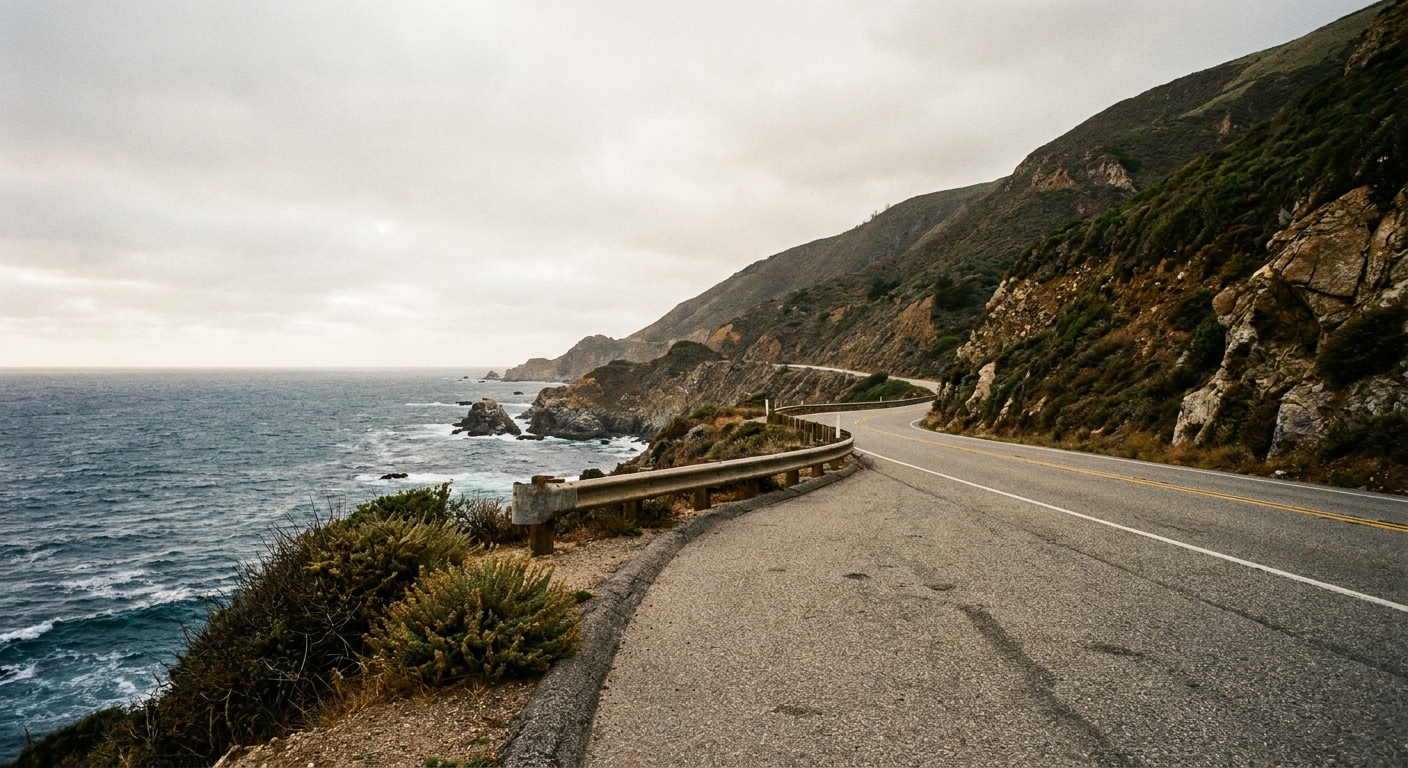
Pacific Coast Highway, California
If you've only got one western drive in you, start here. The ocean is doing most of the work, and the bail-out points are everywhere.
The route in numbers
California's Highway 1 is a designated National Scenic Byway running the length of the state's coast. Taking it from LA to San Francisco adds roughly 100 miles versus I-5, and that's the whole point. The San Luis Obispo stretch alone is MDLINK 2 MDLINK, more cliff-and-ocean per hour than anywhere else in the country.
You don't have to do all of it. Most families pick a three or four-day chunk between Monterey and Morro Bay and call it a trip.
What kids actually remember
The elephant seals at Piedras Blancas. Free roadside boardwalk, no tickets, no lines, just a beach full of giant snoring mammals shoving each other around. Add Hearst Castle, the Monterey Bay Aquarium, and tide pools at any low tide, and you've got a week.
The honest part: PCH has hotels every twenty miles. If hour two goes sideways and the back seat declares war, you can pull off and try again tomorrow. Try that on a desert loop.
Utah's Mighty 5
This is the one for teens who want to climb on things. Five national parks in one state, connected by some of the best driving in America.
Five parks, one loop
Zion, Bryce Canyon, Capitol Reef, Arches, and Canyonlands. Most people run them as a 7 to 10 day loop, usually starting and ending in Las Vegas or Salt Lake. The connector between Bryce and Capitol Reef, Scenic Byway 12, is the kind of road you'll pull over on for no reason other than the view.
Zion alone logged 4.94 million visits in 2024, making it the second most visited national park in the country, behind only Great Smoky Mountains. That number is the warning label.
The crowd problem
Arches uses timed entry in peak season. Reserve early or go shoulder. Zion's main canyon is shuttle-only most of the year, which is annoying the first morning and a relief by day three. Parking at Bryce in July is its own small chapter of the trip.
April and October are the sweet spots. Cooler, quieter, and the red rock somehow looks even more red. If you can pull kids out of school for a Friday, do it.
Going-to-the-Sun Road, Glacier National Park
Fifty miles. Continental Divide. One of the few drives where the road itself is the attraction, and the park is a bonus.
50 miles across the Continental Divide
Going-to-the-Sun Road spans Glacier National Park west to east, crests at Logan Pass (6,646 feet), and is a National Historic Landmark in its own right. It's typically open late June through mid-October. Outside that window, snow.
Glacier itself pulled 3.2 million visits in 2024. Big number, but the park is enormous, and most people cluster around two or three lots.
Reservations and reality
The park has used vehicle reservation systems in recent years for the Sun Road corridor. Rules shift season to season, so check current NPS guidance before you commit to a date. Drive time is two to three hours without stops, but nobody drives this without stops. Plan a full day.
Bighorn sheep and mountain goats on the road shoulder are common, not rare. So is a kid in the back seat losing it because they saw one and nobody believed them.
Beartooth Highway, Montana into Wyoming
Going-to-the-Sun is the famous one. Beartooth is the one the locals send you to.
The highest paved road in the Northern Rockies
68 miles of US 212, peaking at 10,947 feet at Beartooth Pass. It's a National Scenic Byways All-American Road, and it drops you into Yellowstone's quiet Northeast Entrance instead of the West Entrance bumper-to-bumper. Charles Kuralt called it the most beautiful drive in America. He drove a lot of roads.
Short window
Open Memorial Day weekend through early October, weather permitting. The switchbacks are the kind you remember. Alpine tundra above the tree line, lakes still iced over in June, marmots on the rocks. It pairs with a Yellowstone leg through the back door, which means you skip the West Entrance crawl on a July morning. Worth the detour by itself.
One warning: if anyone in the car gets carsick, this is not the road for them. Twelve switchbacks in a row, climbing a wall.
US Route 89, the National Park Highway
This is the big one. The two-week one. The one you save for the summer the kids are 10 and 13 and you can still drag them somewhere.
1,250 miles, seven parks
US 89 runs from Arizona to the Canadian border in Montana. Along the way, it threads or feeds the Grand Canyon, Zion, Bryce, Grand Teton, Yellowstone, and Glacier. The Grand Canyon alone pulled 4.91 million visits in 2024. String enough of these together and you've got more national parks per mile than any road in America.
It's less famous than PCH. That's part of why it works.
Who this is for
Crews with two weeks or more, willing to do some long driving days. It plays better as a one-way (fly into Phoenix, out of Kalispell) than a there-and-back. Pair it with the Grand Circle (Monument Valley, Antelope Canyon, Sedona) for a southwest-heavy version if you don't have the full two weeks.
If you're more of a long-weekend driver, our guide to road trips from Chicago by season has shorter options that scratch the same itch.
Picking yours
Quick matchmaking. PCH for the youngest kids and the easiest bail-outs. Mighty 5 for the teens who want to climb on stuff. Going-to-the-Sun and Beartooth for the crews chasing altitude. US 89 for the people with two weeks and an open calendar.
The windows out here do half the work. The other half is whatever's happening between the headrests. A voice-only scavenger hunt game DashDashBoom keeps the back seat looking out the window instead of down at a screen, which is the whole reason you booked this drive in the first place.
FAQ
What is the 3-3-3 rule for road trips? It's a pacing rule. Drive no more than 3 hours at a stretch, stop for 3 nights max in any one spot, and arrive at your stop by 3pm. Out west, where the distances are huge, treat it as a guideline rather than a law.
What is the best road trip out west? For first-timers with kids, the Pacific Coast Highway is the easiest scenery-to-effort ratio. For national park hunters, Utah's Mighty 5 or US Route 89 deliver the most parks per mile.
How long does it take to do the West Coast road trip? Driving the full Pacific Coast Highway from San Diego to the Oregon border is roughly 900 miles. Plan 7 to 10 days if you want time to actually stop. Four or five if you're treating it as a transit drive.
The map's the easy part. The miles are the trip.