
10 Smart Ways to Find the Best Gas Prices Wherever You Are
Gas is more expensive today than it has been in nearly 4 years. Filling up the tank each week takes a huge chunk out of your budget and every little penny you save helps. Here's a few smart ways to save.

On this page
- 1. The crowd-sourced price apps.
- 2. Cash back stacked on top with Upside.
- 3. The half mile off the interstate.
- 4. Buying on the cheap day of the week.
- 5. Warehouse club gas.
- 6. Paying cash where it actually matters.
- 7. Easing off the pedal.
- 8. Backing off above 50 mph.
- 9. Stripping the roof box and the dead weight.
- 10. Tires, idling, and the maintenance basics.
- Pulling it together
Gas is expensive and finding the cheap station is hard (and time consuming). Half the work is hunting down the numbers and figuring out if its actually worth your time to go down the street. The other half is making the gas you already bought stretch further. Do both and the savings stack up fast...and it means real money in your wallet.
Here are ten ways to win at both. We've ranked the way you actually think about them, from the apps in your pocket to the foot on your pedal.
1. The crowd-sourced price apps.
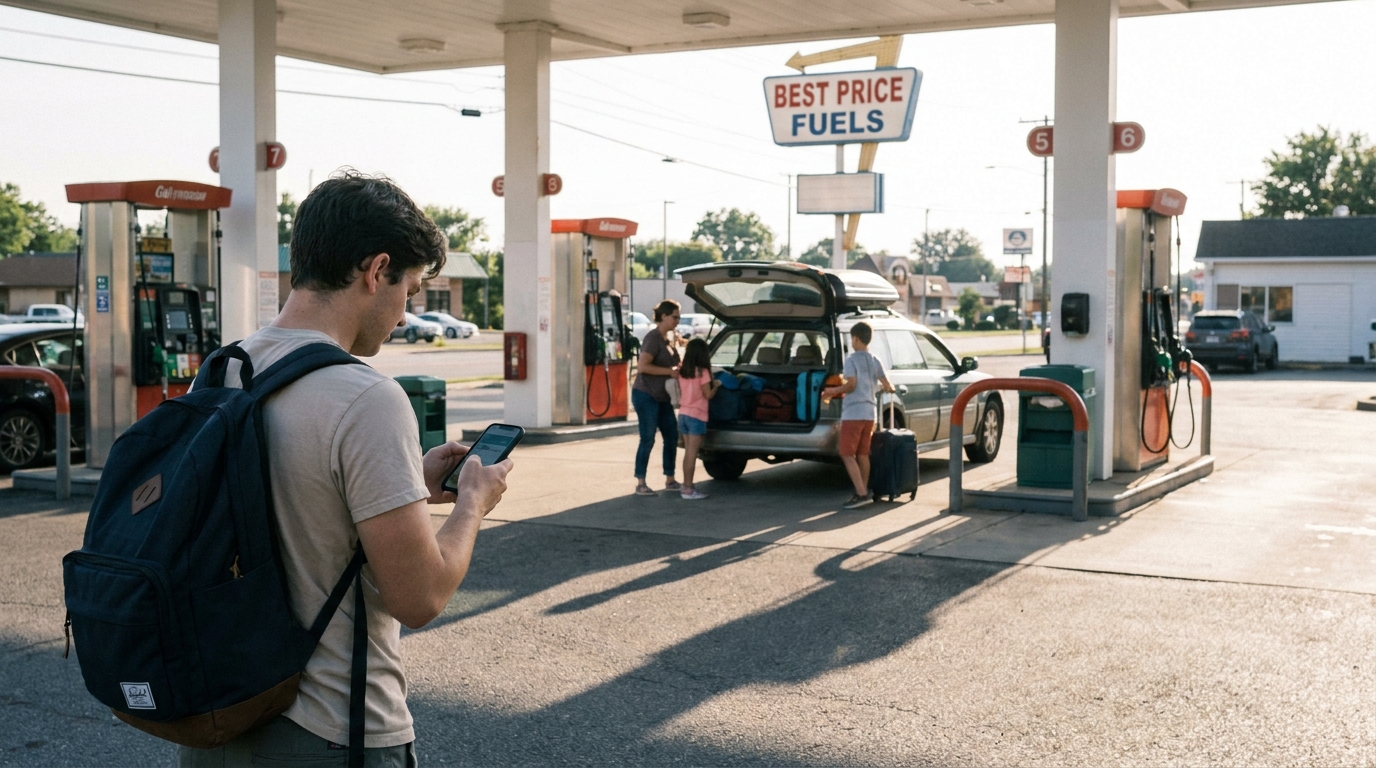
Before you commit to an exit, you can see the whole field. A handful of apps pull live prices from drivers and from the stations themselves, so you're not guessing.
GasBuddy and the live map.
GasBuddy runs on prices reported by other drivers. Someone fills up, taps in what they paid, and that number shows up for everyone behind them. The app has racked up over 100 million downloads, and the company says it's saved users more than $3.1 billion over 20-plus years. That's a lot of pennies adding up.
The real use here is scanning a whole town at once. You're rolling toward a city, you've got four exits coming up, and the map shows you which cluster of stations runs cheap before you pick a lane. No more pulling off blind and praying.
One catch. Crowd-sourced prices are only as good as the last person who reported them. Check the timestamp. A price from three days ago on a fast-moving week means nothing. A price from an hour ago? That you can trust.
If you've ever wondered why two stations on the same map differ so much, the neighborhood gas price breakdown digs into the reasons.
Waze and Google Maps, built in.
You might not want a second app at all. Both Waze and Google Maps now show fuel prices right inside the navigation you're already running. You see the price next to the station icon as you drive past, and you pick on the fly.
This is the move for the driver who doesn't want to juggle screens at 70 mph. The route's already up. The prices are already there. You just glance and decide.
If you hate clutter and want one app doing everything, the built-in option is your call.
2. Cash back stacked on top with Upside.
Here's one most drivers skip because it sounds too good. You can get money back on gas you were going to buy anyway, on top of every other discount you're already getting.
How the claim-before-you-pay flow works.
Upside flips the usual order. You open the app and claim the offer at a station before you pull up to the pump. Then you fill up and pay like normal. A day or so later, the cash back lands in your account.
The app advertises up to 25 cents a gallon on a first fill-up. The number drops after that, but it doesn't go to zero.
The best part is it stacks. Your credit card rewards still count. Your station loyalty card still counts. Upside sits on top of all of it, so it's never an either-or choice. You're not trading one discount for another. You're piling them up.
The offers move around by station and by day, though. Check it before you commit to a pump, not after. There's more on combining tricks like this in our roundup of proven ways to spend less at the pump.
If you fill up at the same few stations every week, claiming an offer takes ten seconds and pays for your coffee. That's who this is for.
3. The half mile off the interstate.
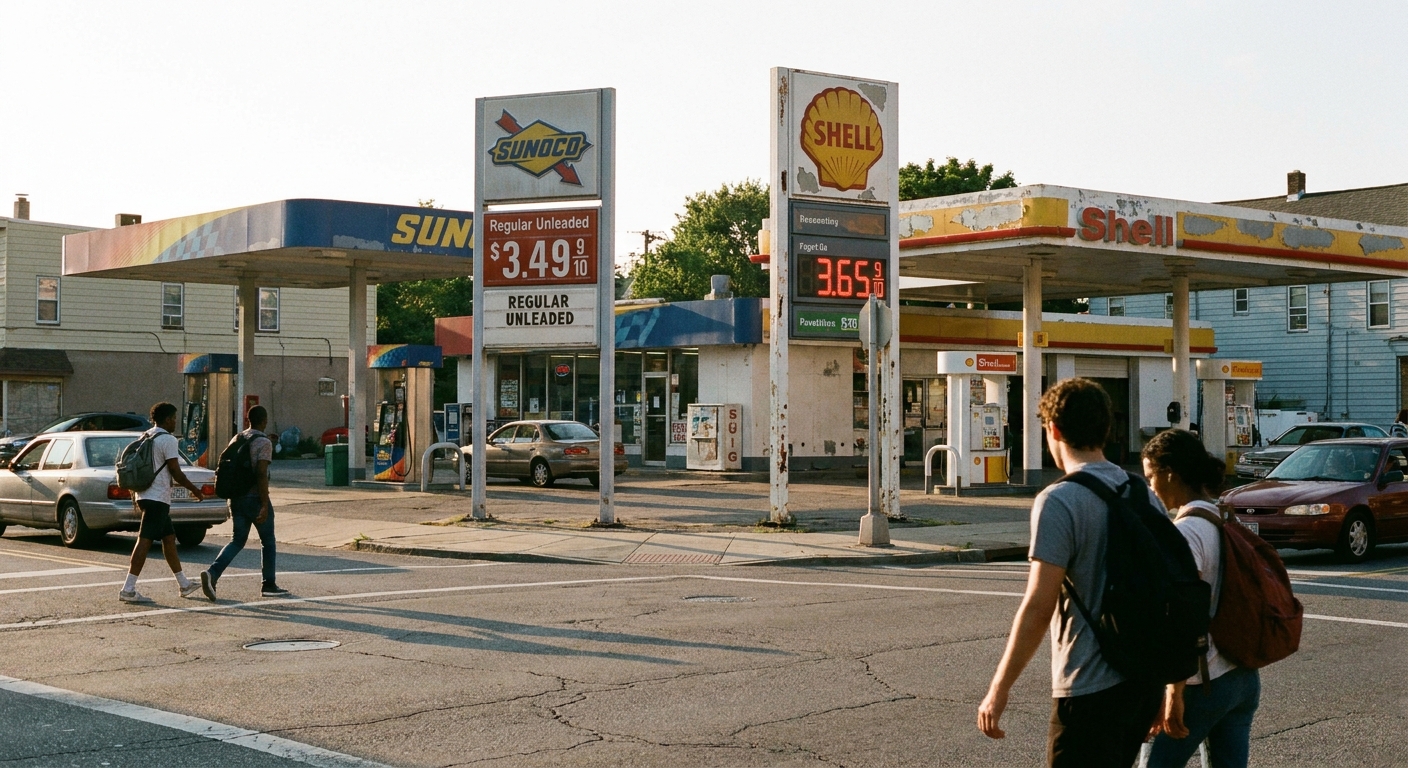
That station you can see from the off-ramp, glowing right there, easy to reach? It's usually the most expensive gas for miles. And it has nothing to do with the gas being better.
Why the highway-exit station gouges you.
Oil companies use something called zone pricing. They set wholesale prices for stations based on a secret weighting of stuff like nearby competition, traffic flow, population density, and even geography. The zone pricing system means one single brand can sell at wildly different prices across one city, even when it costs the exact same amount to make and deliver that gas to every station.
The highway exit is a perfect storm for high prices. Tons of traffic. Drivers who are tired, low on fuel, and not about to comparison shop. The station knows you'll pay. So it charges.
Drive a half mile inland and you often hit a station priced for locals instead of desperate travelers. Same gas. Smaller number.
The refill-timing lottery.
It gets weirder. Two stations on the same block can charge different prices based on something as random as when each one last got a delivery. When a station's wholesale cost drops, the pump price drops with it. When they pay more for their latest tank, the sign climbs.
So the cheap one isn't cheap forever, and the pricey one isn't always pricey. It's partly luck of the refill. Which is exactly why scanning a few options beats loyalty to one corner.
If you mostly drive the same routes, learn which exits run cheap and which ones gouge. Then keep driving past the bad ones.
4. Buying on the cheap day of the week.
Gas has a rhythm, and most people fill up without ever noticing it. Pick the right day and you shave money off before you even pull in.
Monday wins in most states.
GasBuddy crunched the numbers and found Monday is the cheapest day to buy gas in 30 states. Saturday came out as the most expensive in 16 states. The weekend premium is real. Stations know you're traveling, so they nudge the number up.
But the pattern isn't the same everywhere, and that matters. In Illinois and around Chicago, Monday is cheapest and Thursday is the day to avoid. In California, Monday wins again, but Sunday is the worst day to fill up there.
So the rule of thumb is Monday, with a giant asterisk: check your own state. The day that costs you the most at home might be a bargain two states over. If you live somewhere gas runs steep year-round, the California high-price gas tips get into the local quirks.
On a long trip crossing state lines, this gets fuzzier. You fill up where you are when the needle's low. But for your weekly around-town top-off, timing the day is free money.
If you can plan your fill-up instead of running on fumes, this one's for you.
5. Warehouse club gas.
Big box stores didn't get into the gas business by accident. They use cheap fuel to pull you through the door, and you get to ride along.
The 5-to-25-cent gap.
Costco, Sam's Club, and BJ's typically run 5 to 25 cents cheaper per gallon than nearby stations, according to Consumer Reports. That's a serious gap, especially on a 15-gallon fill.
Which club wins depends on where you live. In some areas, BJ's gas beat Costco by up to 12 cents a gallon and Sam's Club by eight. There's no universal champion. It's local.
The cost of entry is the membership. Figure $60 to $65 a year depending on the club.
The math on the membership fee.
Here's where you have to be honest with yourself. That membership only pays off if you buy enough gas, plus enough groceries and other stuff, to clear the annual fee.
Quick math. Say you save 15 cents a gallon and fill up 15 gallons a week. That's about $117 a year in gas savings alone, which clears a $65 fee with room to spare. But if you only fill up twice a month? The numbers get tight, and the membership has to earn its keep on toilet paper and rotisserie chickens.
Run the gallons-times-savings number against the fee before you sign up. If you're already a member, gas there. If you're not, do the math first. That's who this is for.
6. Paying cash where it actually matters.
Look closer at the price sign next time. That big number you're reading might not be the price you'll actually pay at the pump.
Read the big number on the sign.
Lots of stations post the cash price in the giant numbers out front and tuck the credit price into smaller type. You roll in thinking it's $3.09, swipe your card, and somehow it's $3.19. Sneaky.
The cash discount is typically 5 to 10 cents a gallon, per the National Association of Convenience Stores. That's the normal range. But some stations push way past it. One Consumer Reports editor got hit with a 70-cent-per-gallon gap between cash and credit. Seventy cents. On a fill-up that's real money walking out the door.
So before you swipe, find out which price you're looking at. If the cash savings is fat, the ATM run pays for itself.
Why the gap exists.
This isn't the station being greedy for no reason. Credit card processing fees of roughly 1.5% to 3.5% land on the merchant every time you swipe. On thin gas-station margins, that bites.
In states where tacking on a credit surcharge is banned, stations get around it by offering a cash discount instead. Same result, different name. The cash-payer pays less, the card-swiper pays the processing fee baked into the price.
Now, your card might earn rewards that beat a nickel-a-gallon cash discount. Run that comparison. But when the gap is 30, 40, 70 cents? Cash wins, no contest.
If you don't mind carrying a little cash, this one pays you back every fill-up.
7. Easing off the pedal.
You found the cheap station. Good. Now stop torching that cheap gas with your right foot. How you drive moves the needle as much as where you buy.
What aggressive driving costs.
Hard acceleration and slamming the brakes burn fuel fast. The Department of Energy says aggressive driving lowers gas mileage 15 to 30% at highway speeds and 10 to 40% in stop-and-go traffic. Put a dollar figure on it and that's like paying an extra $0.24 to $0.98 a gallon. You bought cheap gas, then drove like you wanted it gone.
The fix barely counts as effort. Ease into the gas. Look ahead. AAA points out that coasting toward a red light instead of charging it and braking hard saves fuel and brake pads both. The light's red whether you race to it or not. So why race?
You don't have to drive like your grandmother. Stop treating every green light like a drag strip. Our list of proven pump-saving moves covers more of these habits if you want the full set.
If you're the lead-foot in the family, this is the one with your name on it.
8. Backing off above 50 mph.
Most cars hit their fuel-economy sweet spot somewhere around 50 miles an hour. Push past it and the math turns against you, fast.
Every 5 mph has a price tag.
The DOE puts it in plain dollars. Every 5 mph you drive over 50 is roughly like paying an extra $0.18 a gallon. So 75 instead of 65? That's about 36 cents a gallon you're handing to wind resistance.
Mileage doesn't drop in a gentle line. It falls off a cliff above 50 because your car is shoving more and more air out of the way the faster it goes. The engine works harder for every mile. You feel none of it, but the tank sure does.
You're not going to crawl down the interstate at 50, and nobody's asking you to. But there's a difference between flowing with traffic and white-knuckling it ten over the whole way. On long flat stretches, cruise control keeps you honest. Set it and stop creeping up.
If you've got a four-hour drive of open highway ahead, easing off a few mph is the cheapest savings on this list. That's who this is for.
9. Stripping the roof box and the dead weight.
Your car's been hauling stuff it doesn't need, and it's been billing you for the privilege at every fill-up.
The cargo box drag tax.
That rooftop cargo box is a sail. The DOE found a roof box cuts highway fuel economy 6 to 17%, and up to 25% at interstate speeds of 65 to 75. In dollars, that's as much as $0.42 a gallon you're paying to drag an empty plastic shell through the air.
And here's the part most people miss. The box doesn't have to be full to cost you. Empty box, full box, doesn't matter much. It's the shape punching a hole in the air that does the damage. So when you're not actively hauling skis or camping gear, take it off. The five minutes it takes to pull it down pays for itself by the next tank.
Weight in the trunk.
Weight matters too, just less dramatically. Every extra 100 pounds in the car cuts mileage about 1%, and the hit is worse on smaller cars where 100 pounds is a bigger chunk of the total.
Go look in your trunk. The bag of sand from winter, the case of water, the box of stuff you keep meaning to drop at Goodwill. It's all riding along, all costing you a sliver of every gallon. Clear out what's been back there since spring.
If your roof rack or trunk has turned into long-term storage, this one's basically free money. We broke down the roof rack fuel cost in more detail if you want the numbers.
10. Tires, idling, and the maintenance basics.
The boring stuff comes last, but it's costing you on every trip. Three small habits, stacked together, add up.
Proper inflation.
Soft tires drag. Keep them at the right pressure and you get up to 3% better mileage, per the DOE. Run them low and you lose about 0.2% for every 1 psi you're down, across all four tires. Two or three psi low on each tire and that adds up.
Check them cold, before you've driven on them. And match the number on the sticker inside your door jamb, not the big number stamped on the tire sidewall. The sidewall number is the tire's max, not your car's target. People mix these up constantly.
Killing the idle.
Idling burns a quarter to half a gallon an hour while you go nowhere. Restarting the engine only takes a few seconds' worth of fuel, way less than people assume. So the old "it's cheaper to leave it running" line is mostly a myth.
AAA's rule is clean and simple. Shut the engine off if you'll be stopped more than 60 seconds. Long train crossing, waiting in a pickup line, parked while someone runs in. Kill it.
Stack all these habits together, the tires and the idle and the light foot, and the DOE says the average driver can improve fuel economy by roughly 10% overall. That's the kind of saving that follows you to every fill-up, no app required. While you're already under the hood, our pre-trip maintenance checklist catches the rest.
Pulling it together
Stack a few of these and the savings compound. Cheap station that's on your route. Cash price instead of credit. Tires up, foot light, roof box gone. None of it is hard. It just takes paying attention.
Here's the caveat most posts skip. Chasing a station 10 miles off your route to save eight cents a gallon costs more in gas and time than you'll ever keep. The low price only counts when it's roughly where you're already headed. Don't let the hunt for cheap gas turn into an expensive detour.
And while the driver up front is quietly running pump math at every exit, the back seat is melting down with nothing to do. That's the gap the DashDashBoom scavenger hunt fills. You handle the gas. The kids handle spotting the red truck.