
11 Proven Ways to Spend Less at the Gas Pump
Your right foot costs more than the station two exits up, and the federal numbers say so.

On this page
The minivan's loaded, the kids are buckled, and the first fill-up of the trip just took a bite out of the snack budget. Sound familiar? Figuring out how to save money on gas starts with one uncomfortable truth: your right foot costs more than the cheaper station two exits up. These 11 fixes all run on real Department of Energy and EPA numbers, so each one carries a percentage you can take straight to the pump.
The driver's foot
Ease off the pedal
This is the big one. Jackrabbit starts, hard braking, and flat-out speeding drop your mileage 15% to 30% at highway speeds, and 10% to 40% in stop-and-go traffic, according to the Department of Energy's gas-saving tips. No other habit on this list moves the needle that much.
Researchers at Oak Ridge National Laboratory ran the numbers and found driving style is the single biggest lever a driver controls, even more so in hybrids. So the smooth pedal in your packed-down minivan does double duty. The tank lasts longer, and the kids in the back feel the lurching less too.
Slow down past 50
Mileage falls off a cliff above 50 mph. Every 5 mph over that line is roughly like paying an extra $0.18 per gallon. That's a 7% to 14% hit depending on the car.
Here's the kicker. That $0.18 figure came from a cheaper era. Regular gas averaged $3.10 a gallon in 2025, per the Energy Information Administration, so the real penalty for white-knuckling it at 78 is steeper than the old number suggests. That long, flat interstate stretch is exactly where the temptation lives. Resist it.
Set the cruise
Most of us micro-accelerate without noticing. A little gas, a little coast, a little gas again. Cruise control holds one steady speed on open highway and skips all that fidgeting.
It pairs nicely with sane pacing on a long haul. If you've read about the 3-3-3 rule for road trips, you already know the value of an even, predictable rhythm out past the cornfield mile-markers. Same idea, applied to your speedometer.
What's riding along
The trunk you never unloaded
Every extra 100 pounds knocks about 1% off your mileage, and it stings smaller cars more. Think about what's back there right now. The gym bag. The case of water. The folding chairs that have lived in the cargo area since spring soccer. None of it is coming on this trip, but all of it is drinking your gas.
The roof box
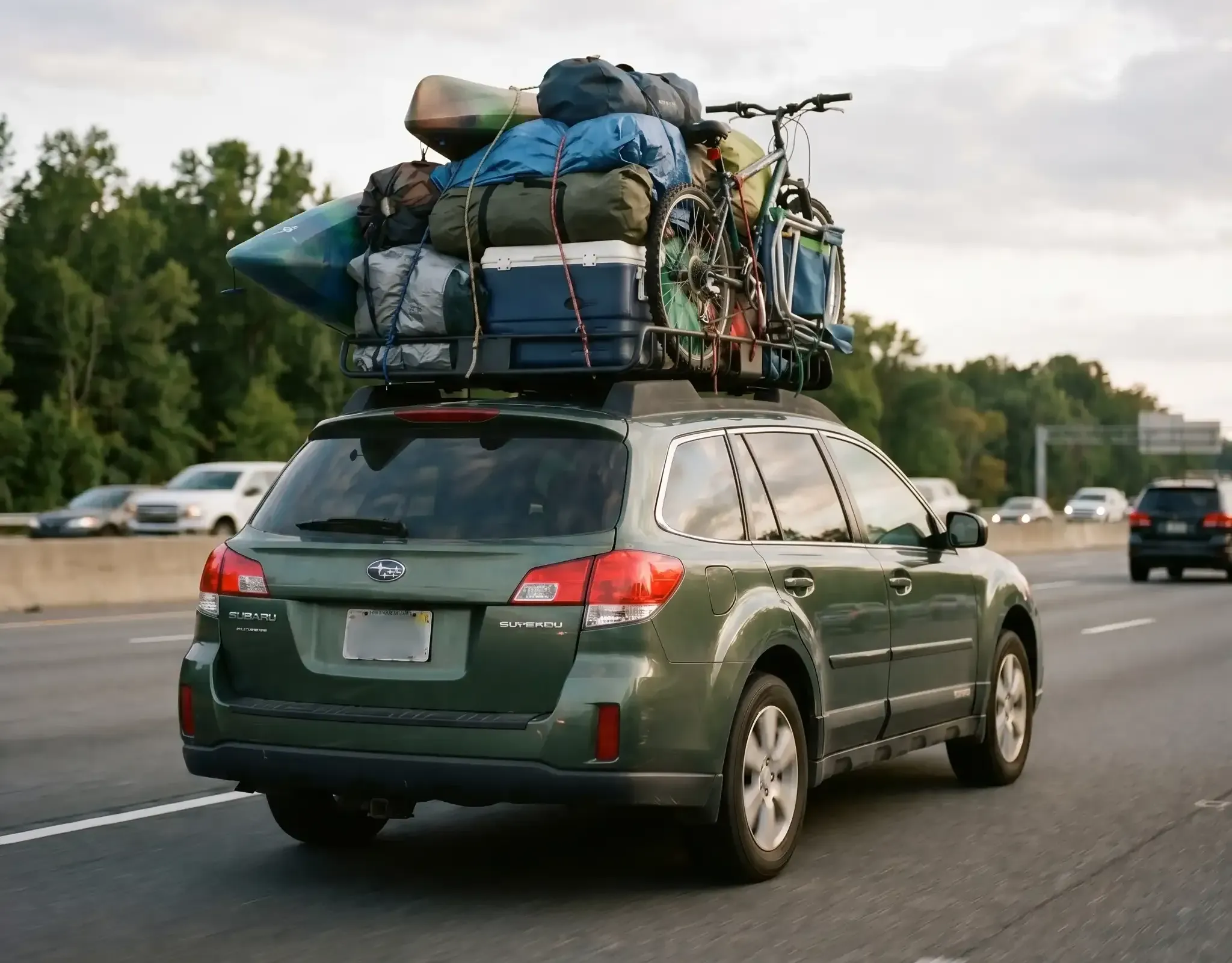
Strap a cargo box up top and brace yourself. A blunt rooftop box cuts mileage 2% to 8% in the city, 6% to 17% on the highway, and a brutal 10% to 25% at interstate speeds of 65 to 75 mph. That's the single biggest drag a road-tripper can bolt on.
A rear-mounted tray costs far less, somewhere around 1% to 5% on the highway. And here's the part people forget: take the box off when it's empty. The wind doesn't care that there's nothing inside it. The drag is the same either way.
Tire pressure
Soft tires waste fuel. Proper inflation improves mileage about 0.6% on average, up to 3%, and underinflation costs roughly 0.2% per 1 psi drop across all four tires.
One honest correction, because half the internet gets this wrong. Use the number on the driver's-side door-jamb sticker, NOT the higher "max" pressure printed on the tire sidewall. That sidewall number is a ceiling, not a target. While you're checking, run through a summer maintenance checklist so the heat doesn't catch you off guard at mile 400, and keep up with the hot-weather car care basics all season.
The engine bay
Don't idle
Idling burns a quarter to a half gallon an hour while you go nowhere. Restarting the engine takes only a few seconds' worth of fuel, so the old "it's cheaper to leave it running" line is wrong. The DOE Clean Cities program, via the National Park Service, pegs idling at up to half a gallon an hour and about 20 pounds of carbon dioxide.
Zoom out and it's staggering. Argonne estimates more than 6 billion gallons of gas and diesel get lost to idling every year across US road vehicles. Kill the engine in a long drive-thru line or at a rest stop. Those minutes add up.
Fix what's broken, use the right oil
A car that's out of tune or failed an emissions test is quietly costing you. Fixing it improves mileage about 4% on average. The right motor oil grade adds another 1% to 2%, and pouring in a heavier grade than the manual calls for costs you that same 1% to 2%. Look for the "Energy Conserving" label on the round API symbol. And batch your errands so the engine runs warm and efficient instead of cold-starting six times a day.
The air-filter myth
Here's one worth flagging. You've probably heard that a fresh air filter saves gas. On a modern fuel-injected car (anything from the early 1980s on, or any diesel) it doesn't. A new filter helps acceleration, not fuel economy. The old tip only applied to carbureted engines. Replace a filthy filter for good airflow, sure, but skip it as a mileage trick.
Shopping the price
Apps that find the cheap station
The brand-name station right at the ramp is rarely the cheapest one around. A price app sorts that out in seconds. GasBuddy says it's racked up more than 100 million downloads and over $3.1 billion in savings over two decades by pointing drivers toward cheaper nearby stations. That's the company's own claim, but the basic move holds: the station two exits up usually wins.
Warehouse clubs
If you fill up often, a membership can pay for itself at the pump. Warehouse clubs like Costco, Sam's, and BJ's typically price gas $0.05 to $0.25 below the local average, per Kiplinger. Consumer Reports notes the fuel discount alone can cover the annual fee for frequent fillers, with memberships running roughly $45 to $120 a year.
You're not alone in caring, either. A Numerator survey found more than 9 of 10 drivers took at least one step to save on gas in the past month.
Stack a few and watch the tank
Pick three or four of these and the DOE figures most drivers improve overall fuel economy by about 10%. Over a summer of fill-ups, that's real money back in the trip fund. The steady foot keeps the tank happy.
The back seat still needs something, though. That's where a round of the DashDashBoom scavenger hunt buys you a few miles while you hold a nice even 58. Point the car, watch the pedal, and let everybody else hunt for red trucks.
Frequently asked questions
How do you save the most money on filling up a gas tank?
The biggest single lever is your right foot. Driving sensibly and staying near the speed limit can cut fuel use 15% to 30% on the highway, far more than any app or fuel grade. Pair that with shopping for the cheapest nearby station and the savings compound.
Does using a cheaper grade of gas save money?
Only if your car is built for regular. Most engines run fine on it, and buying premium when you don't need it just costs more for no benefit. Check your owner's manual instead of the pump's marketing.
What's the best speed for fuel economy?
Mileage drops fast above 50 mph. Every 5 mph past that is roughly like paying an extra $0.18 per gallon at the DOE's baseline price, so a steady speed in the 50s is the sweet spot on open road.