
What Is the 3-3-3 Rule for Road Trips?
RV folks have been quietly using this pacing trick for years, and it's the reason their trips don't end in a minivan meltdown at mile 478.

On this page
The minivan is loaded, the cooler's wedged behind the driver's seat, and someone in the back is already asking how long until we get there. We haven't left the driveway.
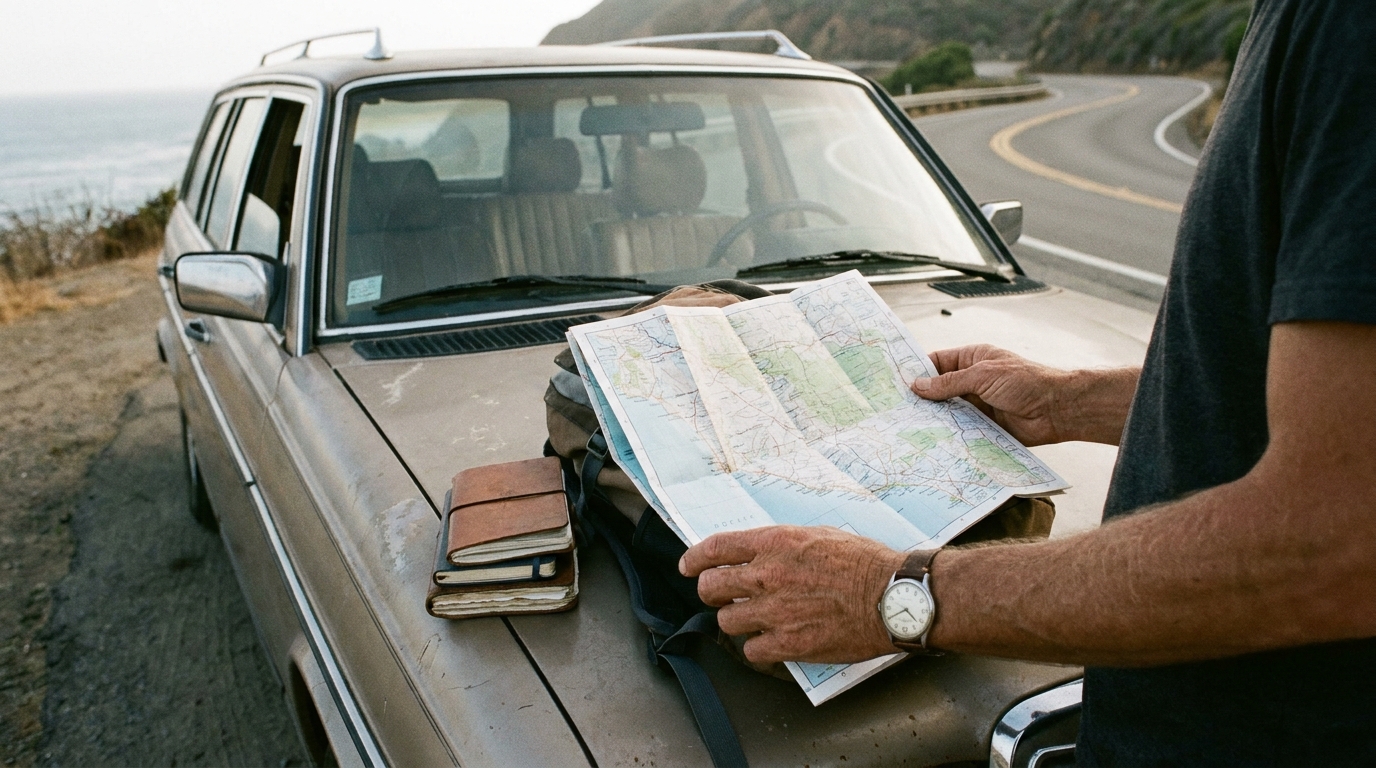
This is the moment the 3-3-3 rule for road trips earns its keep. It's a piece of RV-community wisdom that's spread to families with kids and a Google Maps tab open: drive no more than 300 miles a day, arrive by 3 PM, and stay at least 3 nights wherever you land. It sounds restrictive. Then you do the math on what 500 miles with a six-year-old actually costs you, and it stops sounding restrictive at all.
The rule, in plain English
Three numbers, one idea
The canonical version, as Jalopnik lays it out: 300 miles max behind the wheel, wheels stopped by 3 PM, three nights minimum at each stop. Cruise America credits the RV crowd for the whole thing, and you can tell. The cadence is built for people who hitch a trailer and want to keep their marriage intact.
The logic underneath all three numbers is the same: keep the trip from becoming a forced march.
That's the whole rule. No app, no framework.
The other version floating around
There's a second version in the wild. Islands.com swaps the middle 3 for "take a break every 3 hours" instead of "arrive by 3 PM." Both versions are out there, and neither is wrong. One's about logistics. The other's about cadence behind the wheel.
For context, AAA recommends a break every two hours or 100 miles, which is stricter than either flavor of the rule. If you want a safety floor, that's the one.
300 miles, and why it's lower than you think
The door-to-door math
At a steady 60 mph, 300 miles is five hours of pure driving. Now add gas stops, bathroom stops, a sit-down lunch because everyone is sick of granola bars, and the inevitable meltdown at mile 217. You're looking at seven to eight hours of real time, door to door.
Push past 300 with kids in the car and you've crossed into slog territory. If it's two adult drivers swapping shifts and nobody's under five feet tall, sure, 400 is doable. The 300-mile cap is conservative on purpose.
The drowsy-driving piece
Here's the part the RV forums skip. NHTSA counted 693 deaths from drowsy-driving crashes in 2022. That's the official number. The CDC's research-based estimate puts it as high as 7,500 fatal crashes a year, because drowsiness is almost impossible to prove after the fact. There's no breathalyzer for tired.
The risk math gets worse the less you've slept. CDC NIOSH data shows people running on 6 to 7 hours are twice as likely to be in a sleep-related crash as people getting 8 or more. And drowsy crashes peak in two windows: midnight to dawn, and 2 to 4 PM.
Read that second window again. That's exactly when a driver pushing past mile 350 would still be on the road, fighting the after-lunch fade with a warm Diet Coke. The 3 PM arrival isn't arbitrary. It gets you off the interstate before your body checks out. (A pre-trip driveway check on the car belongs on the same list.)
Why 3 PM, and why 3 nights
The case for getting in early
Most campsite check-ins close in the late afternoon. Daylight matters for setting up. Construction and weather will eat an hour you didn't budget. Anyone who's ever pitched a tent in the dark with a flashlight clenched in their teeth nods at this without needing convincing.
The kid math is just as real. Kids who roll in at 3 PM still have a swim, a hike, a bike loop in them. Kids who roll in at 8 go to bed angry and wake up angrier.
Three nights, or you're driving to drive
The three-night minimum is the part people argue with, and it's the part that quietly saves the trip. One travel day in. One real day at the place. One travel day out. Anything shorter and the destination becomes a rest stop with a hotel attached.
It's also better economics. Spreading your gas and lodging across three nights instead of one means more actual vacation hours per dollar.
The honest counter: this falls apart for short hops. Chicago to grandma's house in Indianapolis isn't a three-night project. Same goes for bucket-list western circuits where you've got 10 days of PTO and want to see Yellowstone, the Tetons, and a chunk of Utah. The rule was born in an RV. It adapts to a family minivan trip from Chicago with some give. Not as gospel.
When the rule bends
Slower variants
Some full-timers and retirees run the 2-2-2 rule: 200 miles, arrive by 2, stay 2 nights. 4-4-4 and 5-5-5 versions exist too, for crews that want longer driving days and longer stays.
The point isn't the specific numbers. The point is a pacing floor, scaled to the trip you're actually taking.
Trips it doesn't fit
Short hops where the destination is the whole point, holidays at relatives', a weekend at the lake cabin. Bucket-list western drives where you've got 10 days and 2,400 miles to cover. Quick weekenders out of Chicago where Friday-to-Sunday is the whole budget.
Use the rule as a sanity check. Not a constitution.
What the rule doesn't solve
Five hours is still five hours
Even a responsible 300-mile day is a full afternoon of staring at the same stretch of interstate. Same cornfields. Same exit signs for a town nobody's ever heard of. Same kid asking the same question about snacks. SAME question.
The rule keeps the driver safe. It doesn't keep the back seat sane.
Classic car games help, and they should be in the rotation. License plate hunt, 20 questions, the alphabet game. They buy you a real hour, sometimes two if you've got the right crew. Past exit 47, though, the shelf life starts to show.
That's the gap the DashDashBoom voice scavenger hunt lives in. Three AI hosts call out things to spot, the back seat shouts what they see, the driver keeps both hands on the wheel. Eyes on the road, voice only. It fills the second half of the drive when the alphabet game has run its course.
The 3-3-3 rule isn't law. It's a pacing floor, and it bends when the trip asks it to. Follow it loosely, ignore it for the weekend run to your in-laws', and know that even a responsible 300-mile day still ends with a sunset somewhere new.